Image Slider

Showing posts with label Economics. Show all posts

Role Of Financial Markets

Financial markets - buyers and sellers can buy and trade a range of services or assets that are fundamentally monetary in nature.

Financial markets exist:
1) To meet the demand for services (such as saving/borrowing, from individuals, businesses and the government)
2) To allow speculation and financial gains

Roles of the financial market include:
1) To facilitate savings - providing somewhere for consumers/firms to store their funds. Savings are rewarded with interest payments from the bank.

2) To lend to businesses and individuals - allows for consumption and investment. The transfer of funds between agents is aided by financial markets. The funds can be used for investment or consumption.

3) To facilitate the exchange of goods and services - the transfer of real economic resources is facilitated in a financial market. Financial markets can make it easier to exchange goods and services from the physical market, by providing a way that buyers and sellers can interact and transfer funds.

4) To provide forward markets in currencies and commodities - in currency markets, speculative attacks can occur which can affect the value of the exchange rate. In commodity markets, investors trade primary products (such as wheat, gold and oil). Future contracts are a method for investing in commodities and involves buying/selling an asset with an agreed price in the present, but a delivery and payment in the future. A forward market is an informal financial market where these contracts for future delivery are made.

5) To provide a market for equities - Equity markets (also known as stock markets) involve the trade of shares. Issuing shares allows companies to finance expansion but people would be unlikely to buy shares if they were unable to sell them on in the future. Returns on the investment, usually in the form of dividends, are based on future performance. A dividend is a share of the firm’s profits.  Financial markets provide the ability for shares to be sold on in the future, making the asset more appealing.
Natural Monopoly

A natural monopoly is a type of monopoly that exists due to the high start-up costs or powerful economies of scale of conducting a business in a specific industry.

Firms with a natural monopoly might be the only provider of a good/service in an industry or geographic location. Natural monopolies can arise in industries that require unique raw materials, technology, or similar factors to operate.

Theme 4: A Global Perspective (Exemplars)

10 Mark Exemplars:

Discuss the likely microeconomic and macroeconomic effects of the reversal of globalisation on the world economy (10 Marks)
A microeconomic effect of deglobalisation could be the reduction in a firm's supernormal profits. Due to globalisation, firms based in developed countries like the United States, have been able to offshore production using the spatial division of labour to countries like China, where there is a cheap and large labour pool as well as low corporate taxation. Consequently, transnational corporations like Apple, operate manufacturing in China and are able to decrease their average costs so they can earn a supernormal profit of P¹ABC.

INSERT GRAPH

However, due to deglobalisation, China could theoretically increase protectionism through tariffs and quotas (as seen by the ongoing trade war between the countries), forcing Apple to reshore production or outsource to countries with higher labour costs and taxes. As a result, supernormal profit will fall to P²DEF and could lead to Apple being competed away by competitors with lower prices.

A macroeconomic effect of deglobalisation could be an increase in unemployment. Using the example above, if foreign multinational corporations were to reshore production from developing countries, this would leave large masses unemployed with Apple alone employing approximately 100,000 people in China. Therefore, a negative multiplier effect would occur in the world economy since the disposable incomes of workers would fall, thus decreasing their marginal propensity to consume. This means there would be less injections into the global circular flow of income and could possibly cause a demand deficient recession which would reverse the positive effects that globalisation has had in reducing worldwide absolute poverty by 21% in 18 years, henceforth increasing mortality rates, reducing the supply of labour, causing a leftward shift in the long-run aggregate supply and global real output to fall.

Total word count: 278
Marks: 10/10

Discuss the likely microeconomic and macroeconomic effects of the reversal of globalisation on the world economy (10 Marks)
If deglobalisation were to occur, it would have a variety of impacts on the world economy. This is because deglobalisation would mean a reduction in world trade and fewer goods and services being transported. Consequently, the productive potential of firms would fall, leading to an increase in average costs and a reduction in the availability of economies of scale due to increased protectionist measures because of the fear of globalisation. This is evident, as the trade war between the United States and China shows the negative impact of increased tariffs and higher barriers to entry which would likely lead to higher prices for goods and services /////. With increased protectionist measures, this would cause the cost of production to rise and thus the average cost would shift upwards from AC to AC¹.
INSERT GRAPH
Despite this, deglobalisation may allow the demand for domestic products to increase and thus, AC to fall to AC³ if resources are available in the country.

Another effect of deglobalisation would be the reindustrialisation of developed countries to boost their domestic economies. This is apparent in the United States as Trump wants to bring back jobs to the US  manufacturing industry to boost its economy. This would likely reduce the number of structurally unemployed workers and increase tax revenue for the government to invest in the economy including increased investment in infrastructure and healthcare. Through increasing government spending on supply-side policies, this would cause aggregate demand to shift from AD to AD¹. This, in turn, would result in economic growth as government spending is an injection and could furthermore lead to a positive multiplier effect.
INSERT GRAPH
However, deglobalisation with the intent to become more independent may be difficult, as evident in the United States as bringing back factories is costly and would increase the national budget deficit which could require contractionary fiscal policies to rectify the issue. This may have a negative impact and cause AD to shift to AD¹ and real output to fall.

Total word count: 326
Marks: 10/10

12 Mark Exemplars:

Assess the view that the benefits of globalisation outweigh the costs (12 Marks)
One benefit to globalisation could be increased employment in developing countries which is evident as FDI inflows to developing economies increased by 7.5% from 2011 to 2012. FDI is when a firm or transnational corporation invests in production in another country; this has been caused by globalisation due to a lack of protectionism in countries such as China who implemented an open-door policy during the 1970s. FDI means that firms in developing countries have greater investment to increase their scale of production of efficiency. Consequently, when firms expand, they demand more labour which is evident in China as employment has increased massively and has lifted more than 500 million people out of poverty between 1990 and 2008. If there is an increase in employment, a positive multiplier effect will occur since workers have a larger marginal propensity to consume and therefore will cause injections into the circular flow of income - increasing AD¹ to AD² and real output to Y² - as a result creating economic growth due to globalisation.
Insert Graph
On the other hand, this economic growth can cause negative externalities due to increased export production in developing countries like China, incentivised by FDI, there has been a lack of government intervention regarding the negative externalities of pollution produced by increased production and economic growth. In the long term, this means the productive workers would face health issues making them unemployable, decreasing the amount of labour supplied. This is especially applicable in China where 36% of pollution is as a result of exports. This would cause AS to shift to AS¹, decreasing long term supply and reducing future economic growth due to the negative externalities of globalisation.

However, another positive impact of economic growth could be increased government tax revenue Whereas transnational corporations which utilise the spatial division of labour have managerial positions and headquarters in their home countries (for example Apple based in California) Hence when they benefit from economies of scale from offshoring manual labour to China, their average cost decreases due to lower regulations and labour costs. Henceforth supernormal profits increase. Consequently, the US government receives high corporate taxation receipts from larger transnational companies like Apple. This can improve the fiscal deficit that the US carries and used for the implementations of supply-side policies in encouraging future economic growth.

However, this has also cause deindustrialisation in the United States as seen by the Rust Belt in the midwest due to Chinese and Mexican outsourcing hence American and other workers in developed countries are subject to structural unemployment causing a demand deficient recession as a consequence to globalisation.
Total word count: 278
Marks: 12/12

=

Strategies influencing growth and development

Market-Orientated Strategies:

These are measures which make the economy freer, with minimum government intervention.

1) Trade liberalisation:
Through the growth of free trade (the act of trading between nations without protectionist barriers, such as tariffs, quotas or regulations) countries can aim for export led-growth. World GDP can be increased using free trade, since output increases when countries specialise.

  • If firms are able to compete globally, living standards might increase and there could be more economic growth which will allow firms to grow as they can export more.
  • However, if firms are unable to compete globally, they will collapse. This will cause a loss of jobs and limit development and growth.

2) Promotion of FDI:
FDI is an investment by a firm/individual in one country into business interests located in another country and generally takes place when an investor establishes foreign business operations or acquires foreign business assets in a foreign company.

  • Firms tend to undertake FDI because production costs are lower in developing countries (BRICS - Brazil, Russia, India, China and South Africa), because it helps promote long term sustainable growth and enables them access to a new market as the innovation of technology is encouraged.
  • For developing countries, more job creation will occur and this leads to the positive multiplier effect since labour productivity increases and results in higher wages. It also provides them with funds to invest and develop, helping to overcome the savings gap (Hong Kong, Singapore and South Korea have benefitted from this method and as a result became developed countries).
  • The transfer of knowledge will occur, with firms bringing staff training and production and management techniques which will benefit the country as labour productivity improves.
  • However, there is often repatriation of profits and workers from developing countries are exploited with low wages and poor working conditions.
  • Countries will also lose some sovereignty and become dependent on another firm. Difficulties may arise for local competition as it becomes harder to set up and compete and the best jobs often go to imported labour, leaving only low skilled jobs for locals.
  • Environmental damage and exploitation of natural resources tend to become greater issues.
Examples:
  • India: the Make In India initiative liberalised FDI policy and led to a 48% increase in FDI in a range of sectors (including pharmaceuticals, manufacturing and railways).
  • Vietnam: Samsung's investment in Vietnam has been crucial. Many local firms are now a part of their supply chain and other businesses have set up around their factories, for example, hotels and restaurants.  
3) Removal of government subsidies
Government subsidies could distort price signals by distorting the free market mechanism and a free-market economist would argue that this could lead to government failure. There could be an inefficient allocation of resources because the market mechanism is unable to act freely. It also has a negative effect on the government budget and could cause excessive debts. 

Globalisation

Globalisation refers to the integration of markets in the global economy, leading to the increased interconnectedness of national economies. It involves the free trade of goods/services, capital and labour and the free interchange of technology and intellectual capital.

Factors contributing to globalisation include:
Trade in goods:

Trade in services:
Trade liberalisation:

Multinational corporations (MNCs):
International financial flows:
Communications & IT:
Containerisation:

Business Objectives

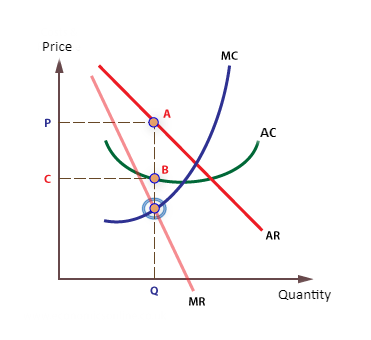
1) Profit maximisation: occurs where marginal cost equals marginal revenue → (MC = MR)
This means selling a good/service at a price where total revenue is at its greatest above total cost → (TR > TC)
It can be seen in the following graph with profits being maximised at Q, with the area of supernormal profits being PABC.
Advantages of profit maximising:

  • It satisfies the interests of shareholders and provides higher dividends for shareholders
  • Profits can be used to pay higher wages to owners and workers.
  • Higher profit levels may lead to increased capital spending which will benefit firms as they reinvest profits into improving and innovating goods/services which ends up benefitting the consumer.
  • It enables the firm to build up savings, which could help the firm survive an economic downturn, as banks will be more willing to lend if the firm has a reasonable level of savings and history of profitability.
Disadvantages of profit maximising:

  • Higher prices for consumers will reduce their real incomes/purchasing power and means a lower level of consumer surplus
  • High profits might act as an incentive for new firms to enter the market – depending on how contestable it is – which in the longer term might reduce the returns to shareholders as competition intensifies
  • Companies that become overly focused on maximising profits might lose sight of the social/ethical/environmental aspects of businesses to the detriment of local communities.
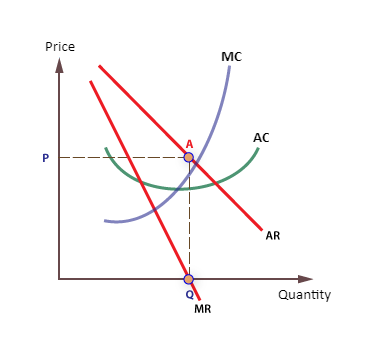
2) Revenue maximisation: occurs where marginal revenue equals 0  →  (MR = 0)
This means selling a good/service at a price which achieves the greatest sales revenue, and for each additional unit sold no extra revenue is generated.
It can be seen in the following graph, with revenue being maximised at A  on the AR curve.
Advantages of revenue maximising:

  • It increases brand loyalty as lower prices attract more customers and will lead to greater exposure. This enables the firm to be more prominent in the market.
  • Other competitors can be competed out of business and this enables the firm to have more market share and profit in the long term.
  • Lower prices for consumers will increase their real incomes/purchasing power and means a higher level of consumer surplus
  • Lower prices and higher sales can help firms with high fixed costs gain economies of scale (lower average costs).
Disadvantages of revenue maximising:


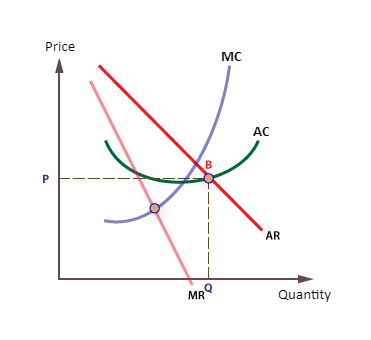
3) Sales maximisation: occurs where average costs equals average revenue →  (AC = AR)
This means selling as many units of a good/service as possible, without making a loss. Firms choose to sacrifice some short-term profit with a view to achieving a longer-term gain.
This can be seen in the following graph, with sales being maximised at B where AC = AR.
4) Satisficing: occurs when a firm is earning just enough profit to keep its shareholders content and for investors to maintain confidence in the management they appoint. When there is a divorce of ownership and control, the principal-agent problem may occur where there are different business objectives.

  • Owners want to profit maximise.
  • Shareholders want to profit maximise since they earn larger dividends from them.
  • Managers have less incentive to profit maximise since they do not receive the same rewards, therefore managers may create a minimum level of profit to keep the shareholders happy, whilst still meeting their other objectives.